Much of China’s winter wheat production was planted later than normal due to heavy rains which interfered with field work. Planting was delayed by around 20 days in Henan province, which alone accounts for 26% of national production. Delays were also seen in neighboring provinces of Shandong and Anhui, which account for 20% and 13% of production, respectively.
In 2020, a paper published in the European Journal of Agronomy specifically looked at yield losses due to late planting of winter wheat, in a corn-wheat rotation in Shaanxi province, which borders Henan to the west.
The study determined that wheat yields declined by 1% for each day that sowing was delayed outside the ideal window.
Due to the delayed sowing of winter wheat in 2025, the Ministry of Agriculture advised farmers to increase the seeding rate of winter wheat.
The 2020 paper examined this strategy. The results were that increasing the seeding rate completely offset the decline in yields for wheat planted with a one-week delay, and only partially offset the decline in yields for a two-week delay.
The authors write: “However, it should be noted that higher seeding rates could not compensate for the yield loss beyond a two-week delay in sowing.” The study was done over four growing seasons (2014-2018), and in the last two years of the study, the researchers also planted separate wheat plots with an increased seeding rate to measure the effectiveness of reducing yield loss despite late planting.

The researchers also looked at 9 other studies related to the delayed planting of winter wheat. Based on the results of those previous papers, they calculated losses of 0.7% for each day that wheat sowing was delayed.
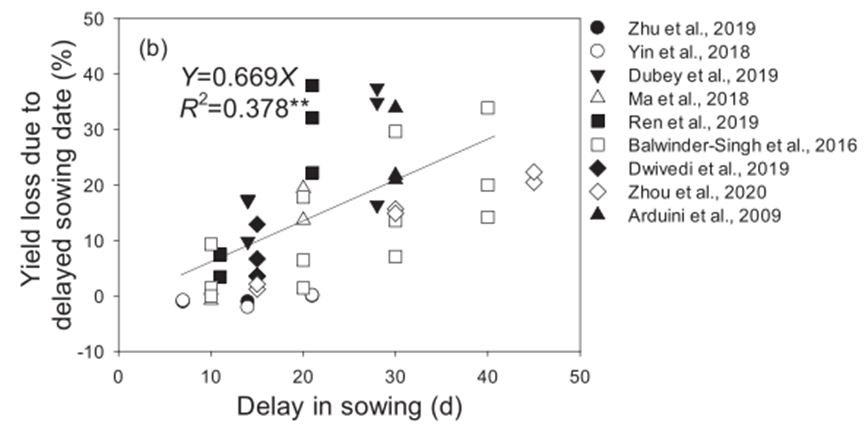
(Yield penalty due to delayed sowing of winter wheat and the mitigatory role of increased seeding rate. Farooq Shah, Jeffrey A. Coulter, Cheng Ye, Wei Wu – European Journal of Agronomy, Volume 119, September 2020)
Quantifying delays
According to the Ministry of Agriculture, the optimal sowing period in Shandong province is October 5-15.
Shandong
This year, 20% was sown in Shandong before October 31. Another 55% was sown from November 1-10. There was 22% planted from November 11-20, and the remaining 3% was planted after November 21.
Being conservative and defining the last optimal planting date as being October 15, that puts 80% of Shandong wheat planting as over 2 weeks delayed.
Henan
For Henan province, the optimal sowing period is October 12-24. As of November 4, 29% of wheat was planted in Henan. From November 5-7, 19% was planted. From November 8-11, another 14% was planted. And from November 12-16, 29% was planted.
As of November 16, 91% of winter wheat was planted, meaning that the remaining 9% was planted after that date.
Being conservative and using the last optimal planting date, if 29% of the wheat area was planted by November 4, that means 71% of the crop was planted at least 11 days outside the ideal planting window.
The largest jump in planting progress was from November 12-16. On November 11, Henan reported 62% planted, and on November 16, they reported 91% planted. Using the latest date of the optimal planting window of October 24, that means 29% of the crop was planted 19-23 days late. Henan’s grain stockpiling agency also said planting was about 20-25 days late.