A recent research paper received attention in Chinese state media for ways to increase China’s self-sufficiency in soybeans.
The paper from researchers at China Agricultural University and the Chinese Academy of Agricultural Sciences calculates that China’s soybean self-sufficiency rate in 2022 has fallen to 17% and is projected to fall to 12% by 2050 without policy intervention.
It looks at three ways to increase self-sufficiency: Increasing planted area, increasing yields, and reducing consumption. If fully implemented, the authors calculate this could increase China’s self-sufficiency to 74% by 2030 and 80% by 2050.
Planted Area Expansion
For expanding the planted area, the authors calculate that there is 10.2 million hectares of salt-affected land that could be rehabilitated and used for soybean production. The estimated cost for this has a wide range of $20.9-104.6 billion USD. They estimated that this could increase soybean production to 39.9 million tons.
One of the constraints here is that some of this land would be in arid or semi-arid regions. The authors note that water availability would be a constraint, and that this depends on “substantial gains” in the efficiency of water use for irrigation.
Expanding production onto this type of land has been a topic for several years now. In 2021, Farmer’s Daily published an article, “Saline-alkali land can also be turned into fertile fields”, which suggested improvement of 2.3 million hectares could yield 10 million tons of grains and oilseeds. Around this time, there was also a focus on strip-planting corn and soybeans as a way to increase soybean production. While this is still a practice in some areas, the idea doesn’t seem to have the same level of government attention and momentum as it did in 2022.
Yield increases through GMOs
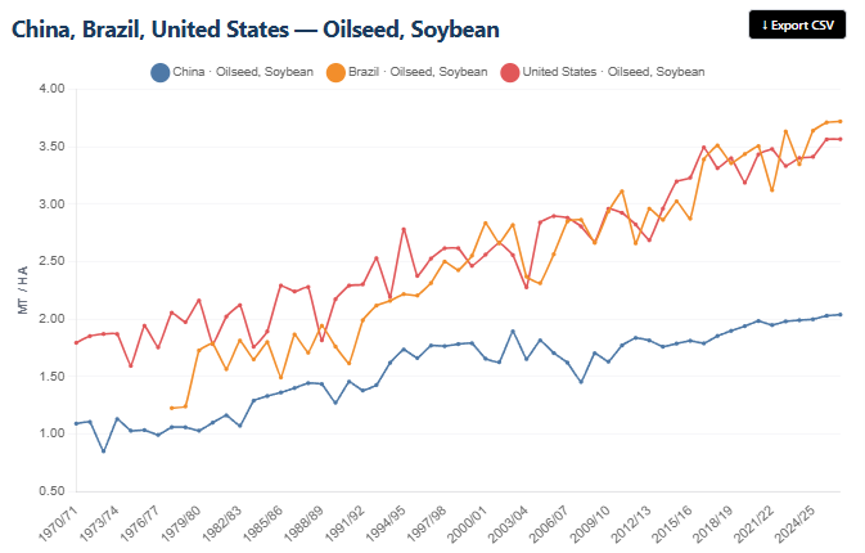
The second area is increasing the rollout of GMO soybean varieties. Soybean yields in China have dramatically lagged behind the US and Brazil, and the authors estimate that a full rollout of GMO soybeans could increase yields to 3.02 tons per hectare, increasing production to 34.3 million tons.
Although China is rolling out GMOs, the yield gap isn’t entirely due to GMOs. Farm sizes in the US and Brazil are larger, and farmers can invest more in equipment to increase efficiency. The other challenge is the acceptance of GMOs in China. The authors note that only 34% of consumers and 51% of farmers accept GMO soybeans.

Dietary changes
The last area is diet. The authors calculate that per capita protein consumption increased by 9.6x, rising from 2kg in 1961 to 19.2kg in 2022, while soybean demand for feed rose by 19.2x. Adoption of Chinese Dietary Guidelines for a healthy diet would reduce consumption of pork, beef, poultry, dairy, and seafood, while increasing the consumption of milk and soybeans directly.
Changes in diets would improve self-sufficiency in soybeans, and there is a trend towards healthier eating. However, the authors note that these changes would face “entrenched dietary preferences” that have been around since the 1980s.
Consumers are eating less pork and opting for other alternatives, such as poultry, beef, and seafood. But it seems unlikely that consumers would want to reduce overall consumption of meat.
In 2020, the CEO of Impossible Foods said: “Every time someone in China eats a piece of meat, a puff of smoke goes up in the Amazon”. This drew a huge amount of criticism in China and even in state media.
The view in China is generally that the country has developed economically, and this has allowed consumers to eat meat more often. Historically, this is a relatively new occurrence, and Chinese consumers shouldn’t be told to eat less meat when developed countries have been consuming larger amounts of meat for a long time.
Challenges in reducing soybean demand
All the methods would increase China’s self-sufficiency in soybeans, but that would be very challenging. For example, if everyone followed the dietary guidelines by reducing meat consumption and increasing soybean consumption, this would increase self-sufficiency. But if people did that at 50% (reducing meat consumption but not fully cutting back to the recommended levels) this would slow, but not reverse, the increased demand for soybeans.
Since the start of the first US-China trade war in 2016, the growth rate of China’s soybean imports has slowed. Domestic production has grown by 54% compared to imports growing by 21%. But, in nominal terms, domestic production rose by 7.3 million tons compared to imports rising 19.5 million tons.
While it may have been beyond the scope of the research paper, it is interesting that reductions in soybean meal use in feed weren’t included. Large hog producers have publicly announced various efforts to reduce their soybean meal use, but the inclusion rates of soybean meal have been steady for the past three years.
Integrated policies could raise China’s soybean self-sufficiency and ease global land-use pressure – Lun, F., Sun, J., Zhou, Y. et al. – Nat Food (2026)