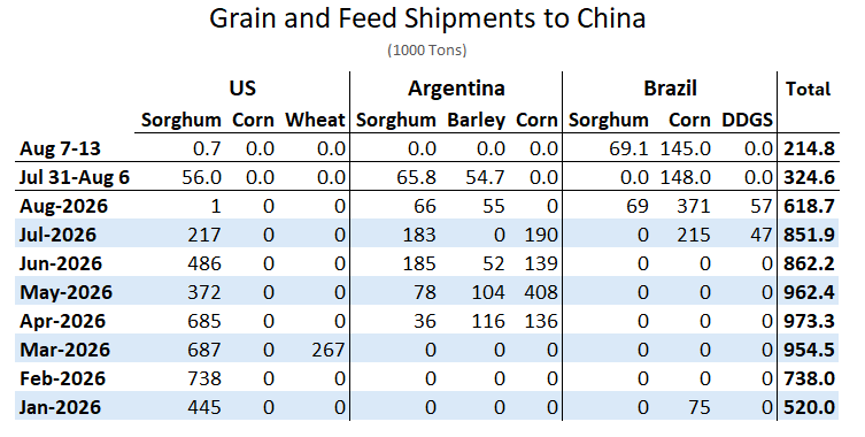
Last week saw the first shipments of sorghum to China in a new trade flow that could disrupt previous export patterns.
China is the largest importer of sorghum, forecast at 6.6 million tons for 2026/27. This is over 20x the volume of the next largest importer, Mexico, forecast at 300k tons.
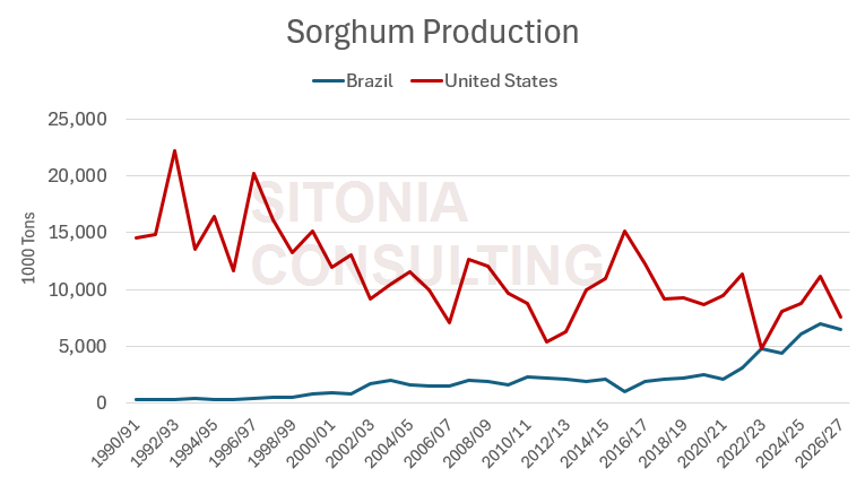
The US remains the largest producer of sorghum, but over a longer term, production has been trending slightly lower. In comparison, Brazil’s production has been rising and is forecast to be the third largest global producer in 2026/27 at 6.5 million tons, slightly behind Nigeria at 7.0 million tons.
Brazilian sorghum production has been growing rapidly in recent years. In 2020/21, production was 2.1 million tons and rose to 7.0 million tons in 2025/26.
Exports were 121k tons in 2024/25. Presently, the USDA is forecasting exports at 100k tons for 2025/26 and 100k tons for 2026/27. There are already multiples of that in the shipping lineup.
An interesting thing is that USDA FAS in Brazil doesn’t publish its own sorghum balance sheets, but only grain balance sheets for corn, wheat, and rice.
Sorghum production is forecast at 6.5 million tons in 2026/27, which would overtake wheat production, which is forecast at 6.1 million tons. But in the latest USDA FAS grain report for Brazil, it is only mentioned once in passing: “In some instances, some areas traditionally used for wheat have shifted to winter crops deemed more profitable and less prone to weather-related risks, such as canola, sorghum, and barley.”
There are currently 619k tons of sorghum in the lineup in Brazil, with 270k tons already listed with China as the destination. Brazil is also actively shipping corn to China, with 371k tons since the start of August.
The US is generally the largest supplier of sorghum to China, but there has been diversification to Australia and Argentina in recent years. Australia took the top spot as a supplier to China last year, with China importing 2.2 million tons of Australian sorghum compared to 807k tons from the US.
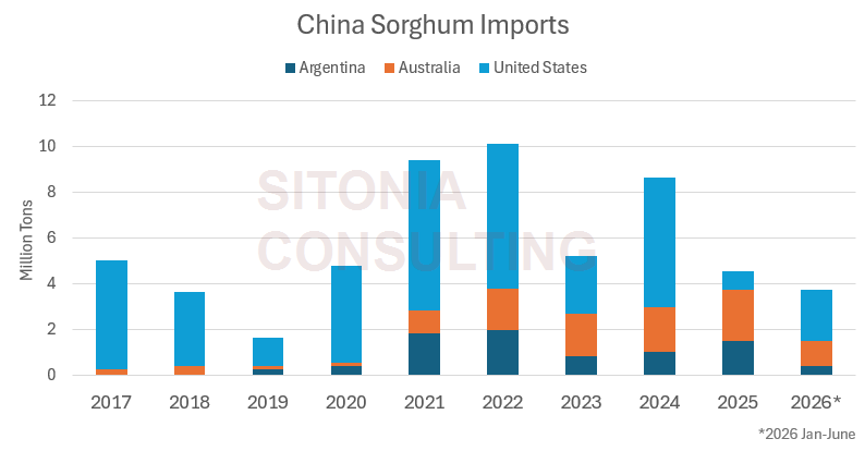
The start of Brazil-China sorghum trade will also pressure the US, especially in the context of the value of trade. US sorghum exports to China hit a peak of $2.1B in 2015, but from 2020 through 2024, had yearly values from $1.1B to $1.8B.
The US-China sorghum trade is well-established and would provide important value to reach the $17B goal but is now facing new competition from Brazil.
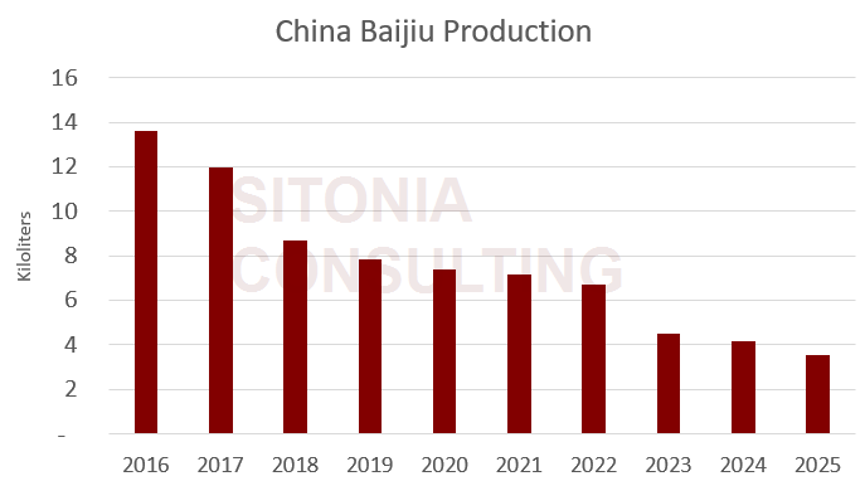
Lastly, sorghum is used in the production of baijiu, but that has seen a structural decline in production from the peak in 2016. The decline is due to the anti-corruption campaigns in China, with officials and businesspeople having less lavish banquets. Expensive bottles of baijiu were also used as bribes.
But it’s also due to younger generations drinking less. Beer production peaked in 2013, declined for several years, and stabilized after 2020. Baijiu production has seen a much steeper decline, with health-focused younger generations drinking less, and specifically drinking less baijiu, which tends to have a very high alcohol content and strong flavor. The changing dietary habits in China are being seen not just in baijiu production, but, as mentioned yesterday, the upgrading in grocery consumption, and also in protein choices, with poultry, seafood, and beef growing in popularity, while consumption of pork is falling despite being cheap.