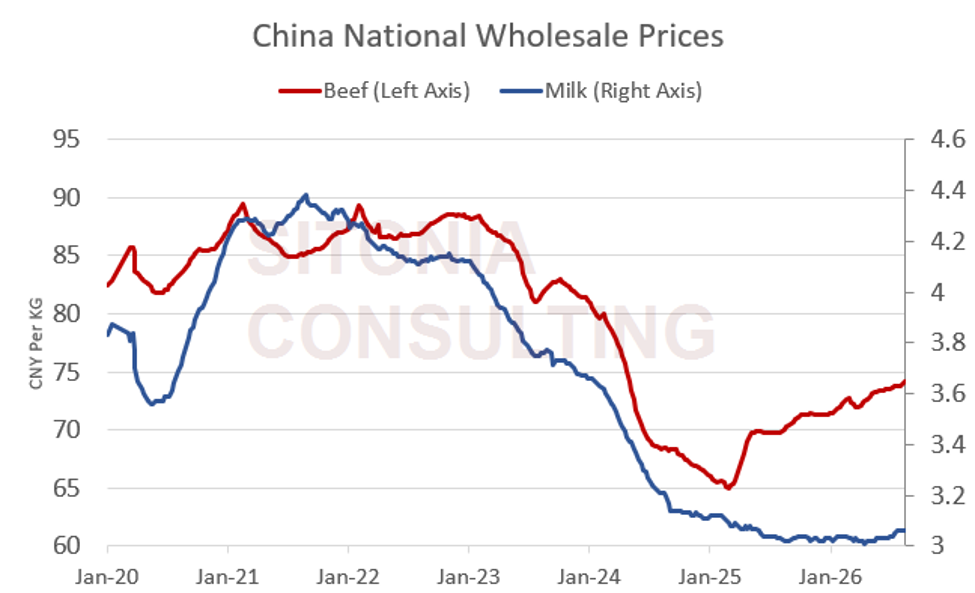
The rise in cattle and beef prices was the subject of a recent news report on CCTV Finance.
Vendors at Beijing’s Xinfadi wholesale market note a trend of both rising prices and rising demand. Prices of beef shank at the market are up 7.0% over the past month, and up 18.8% year on year. One vendor notes he is selling about 10 cows per day, compared to 6-7 previously.
The increase in demand despite rising prices is notable in terms of price elasticity.
The decline in pork prices didn’t lead to increased demand. However, once egg prices rose, that led to an increase in pork consumption.
Beijing’s Xinfadi market has pork prices down 16.1% year on year and egg prices up 50.8% year on year. Commentary from the market is that this led to an increase in pork demand, specifically from company cafeterias switching some purchases away from eggs and to pork.

Demand for beef is also increasing due to stockpiling ahead of the Mid-Autumn Festival and National Day holidays, with processing plants running close to capacity in nearby Shandong.
One processing plant manager noted a shift in consumer preferences. In the past, they mainly sold frozen products, but they noted an increase in demand for fresh beef. There has also been a change from selling large cuts towards selling ground, diced, or sliced beef that is more convenient for everyday consumption.
A farmer in Hebei with a herd of 450 cattle estimates he can currently earn a profit of 2,000-2,500 yuan per cow. He noted that the past two and a half years had been loss-making, with the lowest period seeing losses over 2,000 yuan per cow.
Compared with other livestock like hogs, the cattle industry has a relatively low level of consolidation. An official with a local Ministry of Agriculture office in Hebei noted that with improvements to genetics and feed rations, farmers have been able to reduce costs by about 5%.
Imports of beef from January through August total 1.75 million tons, up 12.5% year on year. This was due to faster shipments out of Brazil and Australia due to the country-specific import quotas that the Ministry of Commerce introduced in 2026.

Australia and Brazil have exhausted their quotas, leaving Argentina, Uruguay, the United States, and New Zealand as the only specific countries with remaining quotas, plus the additional quota for unspecific countries.
Based on customs data through July, that leaves 924k tons of import quota across those four countries, plus the unused quota for other unspecified countries.