Yesterday, 25 large companies met with the National Development and Reform Commission and the Ministry of Agriculture in Beijing to discuss plans to reduce the size of the country’s hog industry.
The government reiterated that the sow population needs to be reduced by 1 million. The sow population has been relatively stable in recent months and was at 40.42 million in July.

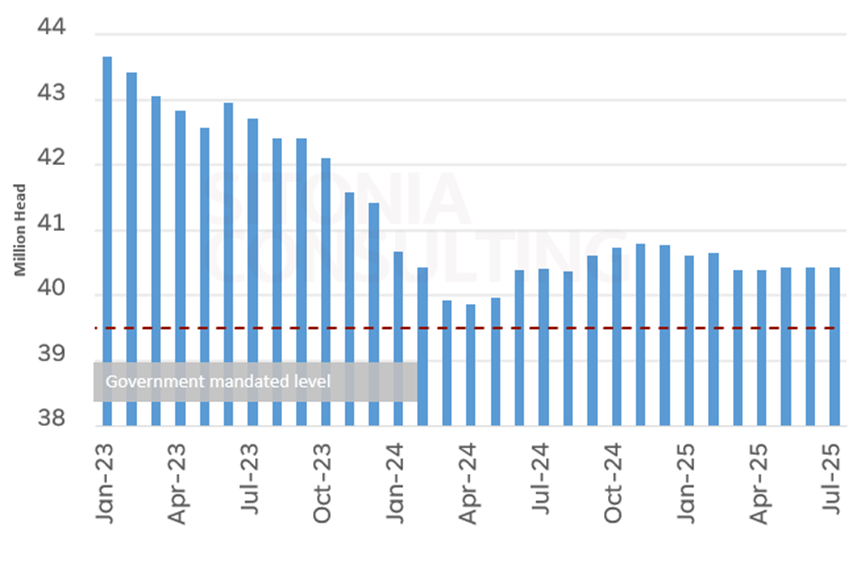
Other reported measures seem much stricter.
This includes that provinces will also be responsible for reducing their respective sow herds as part of reaching the national goal of reducing the sow herd by 1 million.
This would be an important development because it shifts from more abstract guidance from the central government to a goal that the provincial officials are expected to achieve and enforce.
Large companies are expected to reduce their production by 10% in 2026. This is also something that has “teeth” from a regulatory perspective.
Before, sow reduction was a vague industry-wide target. Large companies could reduce their sow herds slightly to show they were trying to comply with the guidance and potentially focus on increasing their per sow yields.
But now, provincial level officials are being tasked with reducing the sow herd in their provinces, and companies are being told to cut their output in 2026.
Other actions to reduce production were also reiterated, such as limiting hog weights to 120kg and stopping the practice of secondary-fattening.
Lastly, the NDRC called on different financial regulators and local officials to control lending to hog companies, especially for anything related to capacity expansion. Local governments are also to reduce subsidies to hog producers.
This is a very dramatic policy reversal in a relatively short period of time. In less than five years, local governments have gone from saying things such as “efforts should be intensified to attract investment and support the construction of high-standard, modern, large-scale pig farms with a capacity of over 10,000 pigs” to now trying to limit hog production and prevent any increases in capacity. It also means a headwind for feed demand going into 2026. In 2024, hog feed accounted for 45% of animal feed

