National average wholesale tomato prices hit 9.02 yuan per KG at the beginning of January, according to market monitoring from the Chinese Ministry of Commerce. This is the highest on record, going back at least 10 years.

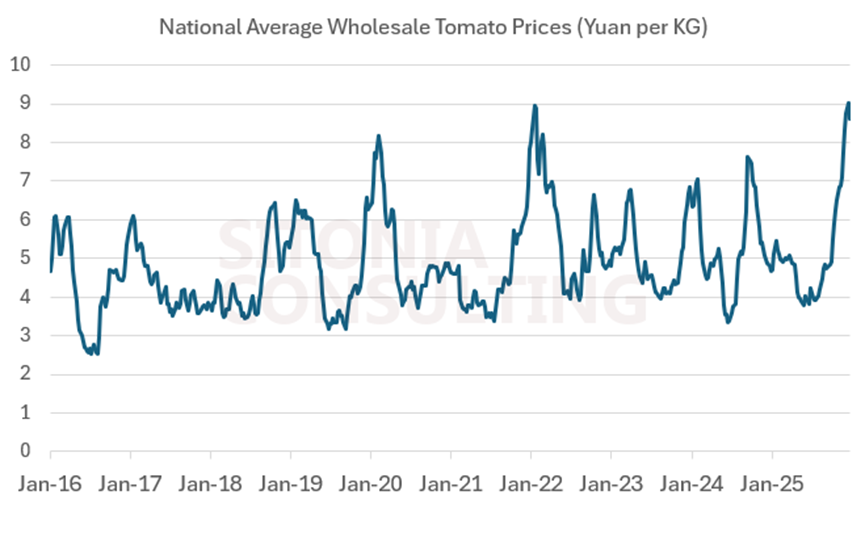
Prices are up 80% year on year, and up 120% since the beginning of August.
According to the Ministry of Agriculture, prices in December 2024 were 7% lower than the seasonal average, and good weather conditions in the first half of 2025 led to increased production and lower prices. This led some farmers to reduce their planting, but there was also heavy rainfall in the autumn in major tomato-producing areas. This reduction in planting, along with adverse weather, led to the current price spike.
As reported last week, December CPI rose 0.8% year on year, the highest in nearly two years. Vegetable prices were up 18.2% year on year, which contributed an increase of 0.39 percentage points to the index. In comparison, pork price fell 14.6%, which contributed a decline of 0.20 percentage points.
Shandong province is the largest producer of tomatoes, and neighboring Henan and Hebei are also large producers.
These three provinces also account for 26% of China’s corn production. The same excessive rains that led to a reduction in tomato output also affected corn that was close to harvest. However, the National Bureau of Statistics still reported that grain production in these provinces increased year on year, and that China had a record corn crop in 2025.
Fruits and vegetables are perishable products that can’t be stockpiled. Because of this, China sees more volatility in the prices of these commodities. The price spikes in fruits and vegetables tend to be short-lived due to shorter growing cycles and more geographically diversified production, due to government policies that require a certain amount of a city’s vegetable demand to be grown locally.
The heavy rains during harvest caused issues for crops in northern China. In some cases, farmers were harvesting corn by hand in flooded fields, and there were subsequent problems with mold in the harvested corn. Similarly, vegetable farmers were dealing with flooded fields and structural damage to their greenhouses.
The impact of these heavy rains is now being reflected in vegetable prices, but it was not reflected in this year’s corn production statistics.
However, they are starting to be reflected in the corn market.
Last week, Sinograin auctioned around 400k tons of corn, with about 200k tons being imported corn, although these auctions are “invitation only”, so there is less transparency on the prices and volumes. Sinograin auctioned about 30k tons of corn in Jilin on Monday, which apparently fetched a premium.
Production in the northeast was higher this year and didn’t face the weather challenges seen in northern China.
In a recent report, Heilongjiang’s grain stockpiler notes that farmers in the province have sold over 50% of their grain, and this is a faster pace than last year. It also noted that feed companies are only buying what they need due to losses in the hog sector, and industrial processors have stockpiles significantly smaller than in previous years.
Heilongjiang is the largest corn producer in China and definitely saw increased production based on good growing conditions this year, and this is also supported by remote-sensing data.
Corn production in the province was higher, and farmers are reportedly selling faster than in previous years. This would mean a large amount of supply on the market.
At the same time, feed producers are only buying what they need because hog farms are losing money, and industrial processors aren’t stockpiling corn. The Ministry of Agriculture even noted the low corn inventory levels of industrial processors in its January China Agricultural Supply and Demand Estimates (CASDE) on Monday.
Larger supply and weak demand should mean lower prices, but over the past month, cash prices in Heilongjiang are up 20 yuan per ton.
One way to explain these contradicting data points is that a large amount of corn is flowing out of the northeast and to areas of northern China that were hit by the heavy rains at harvest. In that case, very expensive tomatoes are also telling us the quality or quantity of corn in northern China.