With imports of grandparent breeding stock into China currently being disrupted due to avian flu outbreaks in France, it’s a good opportunity to look at the trends and players in the Chinese poultry market.
In its China Poultry Annual, the USDA FAS projects 2026 chicken meat production to rise slightly due to large vertically integrated producers continuing to expand production.
USDA FAS estimates chicken meat production at 16.2 million tons in 2025, up 5.5% year on year. 2026 production is estimated at 16.7 million tons, up 3.1%
China has yellow-feather chickens which are domestic breeds used in Chinese cuisine and tend to be smaller and have slower growth. White-feather chickens tend to be imported breeds that have faster growth and are used in fast food restaurants like KFC or McDonalds.
White-feather broilers account for around 70% of production, with yellow-feather broilers at 20%, and hybrid breeds at 10%.
Poultry consumption is increasing for a variety of reasons. Chicken is generally cheaper than pork, and it’s also seen as healthier among the more health-conscious younger generations. It also tends to be a more common protein choice in fast food restaurants, and that segment of the market is also growing.
Increasing poultry consumption in China will continue to be a main driver of growth as pork consumption has peaked, but with better feed conversion ratios for poultry, this won’t drive the same level of growth in feed that was seen when pork consumption was increasing.
Starting upstream, Shandong Yisheng Group (002458) accounted for over 40% of China’s imports of grandparent breeding stock in 2025. The company said that total imports of breeding stock fell over 10% in 2025, which should be positive for prices of parent breeding stock into 2026.
The company’s sales of chicks have fallen in recent years. 2023 sales were 264 million, 2024 sales were 239 million, and 2025 saw sales of 203 million.
The company also reports sales of its 909 series, a medium-weight white feather broiler, which was the first domestic breed to receive national certification, but sales have been relatively steady in recent years.


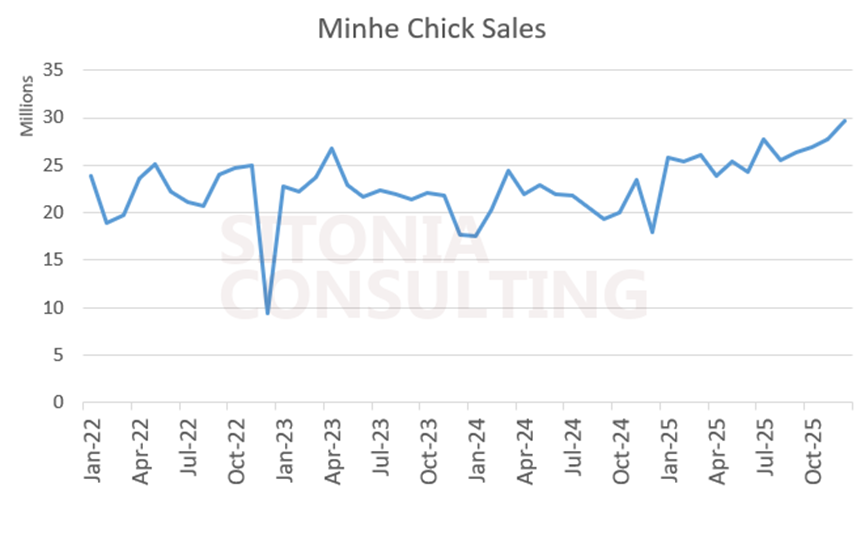
Also in the broiler chick space is Shandong Minhe (002234). The company sells broiler breeding stock but is more vertically integrated and runs its own broiler operations. In 2024, 39% of revenue came from sales of broiler chicks, while 53% came from the sale of chicken products.

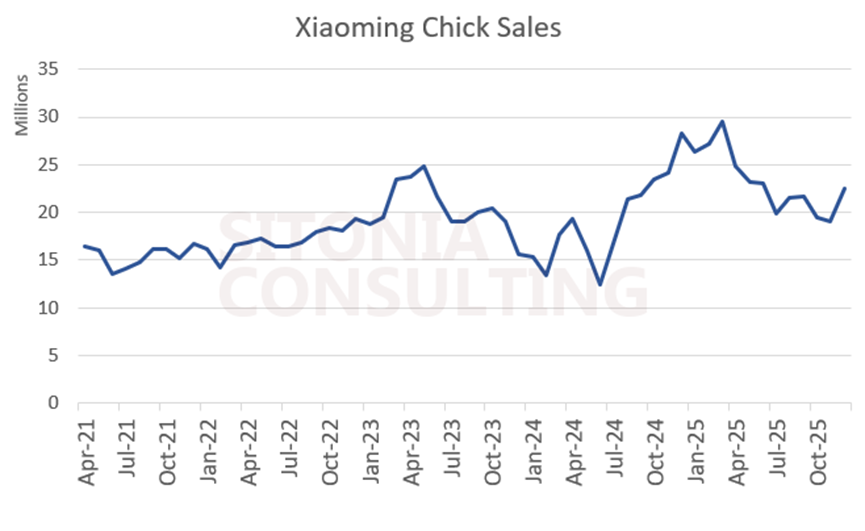
Lastly, there is Xiaoming (300967), which focuses on breeding stock for laying chickens. The company sold 235 million chicks in 2023, but this fell to 228 million in 2024, although revenue increased by 17%. The company has a market share of 21% and also has some vertical integration, including feed production.

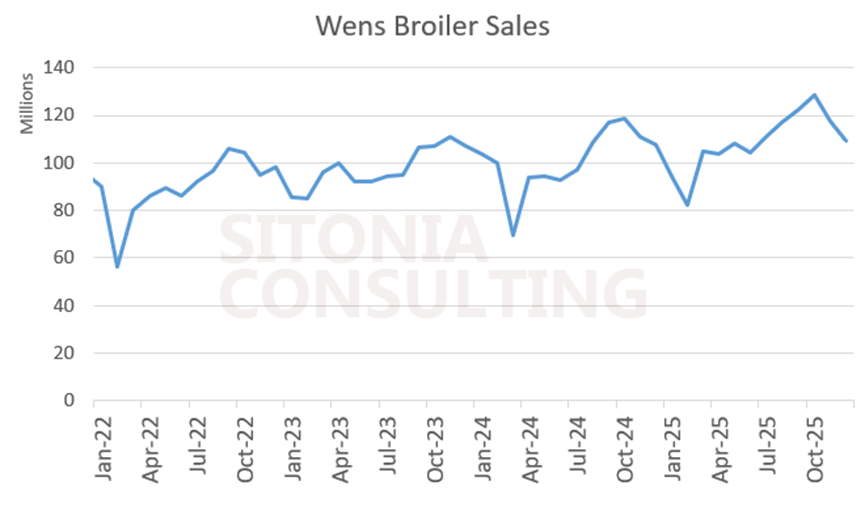
In broiler sales, Wens Group is the largest player and reported broiler sales of 1.30 billion in 2025, up from 1.21 billion in 2024. Most of the company’s revenue comes from the sale of hogs, which accounted for 62% of revenue in 2024, while sales of broiler chickens accounted for 34%.

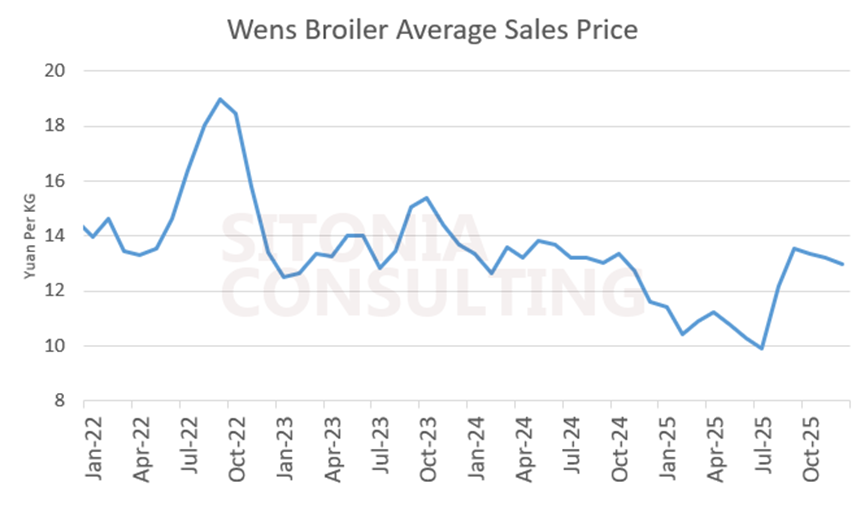
The average selling price has fallen in recent years, and was below 10 yuan per KG in July 2025, but has since rebounded to around 13 yuan per KG.
Further downstream, there are several companies that are more vertically integrated and are more involved in processing.
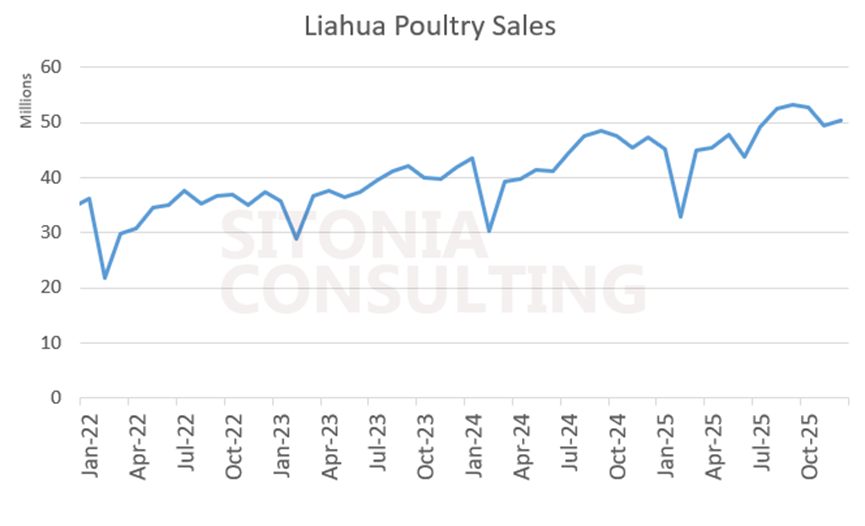
Liahua is a poultry producer which mostly focuses on yellow-feather chickens.
The company has seen steady growth in production in recent years. At the end of 2024, the company had 7,109 farms it worked with, and the average farm produced 67.7k chickens.
The company is expanding more downstream. In the first half of 2025, the company sold 260 million chickens. The company has an annual slaughter capacity of 135 million and was aiming to process 100 million in 2025.

Xiangjia (002982) is an example of a vertically integrated poultry producer. The company contracts with farmers to raise the chickens. The company supplies the chicks as well as feed and veterinary drugs. The company then processes and distributes the chickens and products.
The company sells live chickens, but this only accounted for 20% of revenue in the first half of 2025. Most of the company’s revenue comes from the sale of chicken products, such as packaged chicken breast, thighs, or wings that are sold in grocery stores.
Although production is outsourced to contracted farmers, the company is also investing in its own ‘smart’ farms similar to the advanced hog facilities currently in China, with automated feeding and monitoring of livestock.
Broiler output by large firms continues to grow along with increased consumption of poultry meat. Disruptions to imports of breeding stock will take time to flow downstream to parent-generation and finally commercial broilers but could raise prices. This would also be happening around the same time that the government’s efforts to reduce capacity in the hog herd are also being seen in the price consumers pay for pork and could be inflationary for food prices in the second half of 2026.