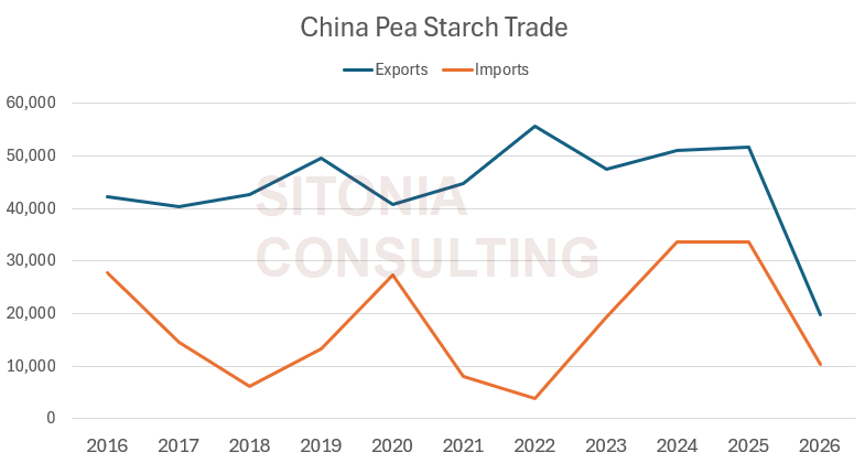
Following an investigation first announced in August 2025, China’s Ministry of Commerce determined that Canadian pea starch was being dumped into China and announced an anti-dumping tariff of 73.5% which goes into effect on July 1.
Peas, along with pea starch and protein, have seen a large amount of tariffs and trade restrictions in recent years. The trade disputes also illustrate an aspect section of Chinese trade and policy.
China is a large net importer of peas and the leading processor in the industry, Shuangta, estimates it has a 40% global market share in pea protein.
However, most of this is exported due to strong demand overseas for use in alternative meat or high-protein health supplements.
From China’s perspective, this is good. Leading companies import a bulk commodity, process it into something more valuable, and then export a higher-value product.
But from the perspective of China’s trading partners, they see it as subsidized Chinese companies that are undercutting domestic companies, while also blocking other trade, such as exports of Canadian pea starch to China.
In 2023, the US began an anti-dumping investigation into Chinese pea protein exports, which are often used in meat alternative products. In 2024, the US announced a dumping rate of 122.2% for most Chinese companies and a subsidy rate of 15.15% for a subsidiary of Shuangta, China’s largest player in the space.
In March 2025, China imposed 100% tariffs on Canadian agricultural products, including peas, as part of the trade disputes between the two countries, triggered by Canadian tariffs on Chinese electric vehicles, steel, and aluminum.
These were lifted on March 1, 2026, following a meeting between Xi and Carney.
One of the applicants for this anti-dumping investigation into Canadian pea starch was also Shaungta, with the Ministry of Commerce stating that import prices were 263-683 yuan per ton lower than domestic prices in China.
China imports rose sharply from 2023 through 2025. Most of this was driven by increases in imports from Canada, which accounted for 71% of imports in 2025.
In 2025, the EU Commission also started an anti-dumping investigation into Chinese pea protein exports. In April 2026, the EU imposed anti-dumping duties ranging from 40.5%-67.4% of Chinese pea protein exports, with Shuangta seeing a 67.4% duty.
It’s also worth noting that despite the increase in pea starch imports in recent years, China is a net exporter of pea starch, with South Korea, Thailand, and Myanmar being the main destinations.