China announced it is extending the anti-dumping investigation into pea starch from Canada through February 12, 2027. On July 1, China put a 73.5% anti-dumping tariff on imports of Canadian pea starch.
As noted on June 30th (China announces 73.5% tariff on Canadian pea starch), this trade has become relatively contentious and complicated, with the US and EU doing anti-dumping investigations on Chinese pea starch, and now China doing an anti-dumping investigation on Canadian pea starch.
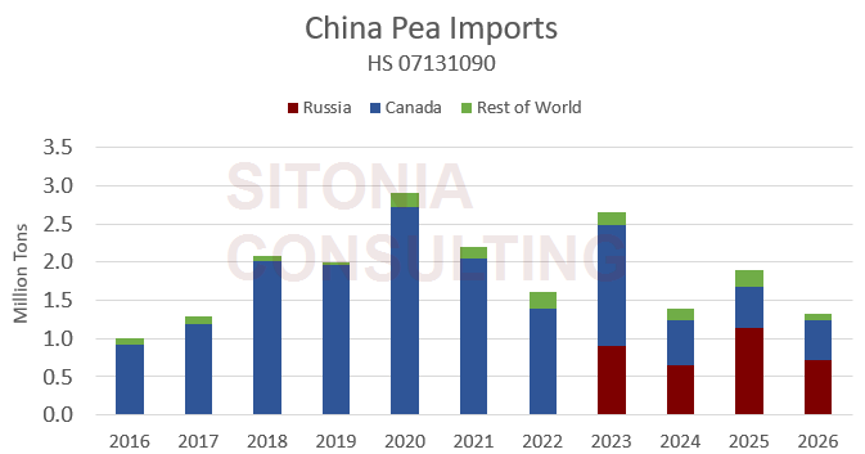
Canada has typically been the largest supplier of peas to China, but in recent years there has been an increase in imports from Russia.
China has traditionally been an exporter of pea starch, but imports grew in recent years, primarily driven by increased imports from Canada.


While this is a relatively small market in the broader scheme of agriculture, it does illustrate a larger tension in international trade. China has its homegrown companion in Shuangta, which estimates it has a 40% global market share in pea protein.
That has worked under the traditional model that is also present in soybeans. Rather than importing an expensive final product in the form of meat, or even a cheaper intermediate good such as soybean meal, China set up import taxes to incentivize imports of the cheapest product in the value chain, in that case, soybeans.
Everyone was generally happy with that model. China is growing, it imports more food, and other countries can supply China with that needed food.
In recent years, that model has shifted. Faced with a declining population and slowing growth in domestic demand, Chinese agricultural companies have increasingly looked to expand overseas. Chinese firms have also become very efficient in many markets.
Pea starch and pea protein are one example. China has started large exports of soybean oil, has become a net exporter of poultry, and continues to grow exports of other products like amino acids and malt barley.
In the past, there were concerns and issues about market access within China. But this is set to become a larger issue in the coming years as China becomes a larger exporter of agricultural products.
A good example of this is corn. China is able to limit its corn imports under its WTO agreement from 2001 in order to protect its farmers from competition. At the time, it was a much less developed country.
Since then, it has developed sophisticated corn processing plants, and in 2026, other countries are putting anti-dumping tariffs on Chinese exports of corn-derived products such as lysine.